
2025 Best Article or Book Chapter
The winner of the 2025 SSA Best Article or Book Chapter was Veronika Szeghy-Gayer for her article, Former Hungarian civil servants on the territory of Slovakia amid the first years of the Czechoslovak Republic, 1919-24: a case study on the status regulation of teachers and postal employees. European Review of History, 31(5):739-758. (2024)
Szeghy-Gayer’s study of former Hungarian Civil servants in the first year of the Czechoslovak Republic presented a new argument to Slovak history that not only were Czechs willing to adapt to political transition for job security after the establishment of Czechoslovakia, but Hungarians were as well. In her article, Szeghy-Gayer puts a human face on big transitions in the Slovak experience. And her examination of employment survey archives answers key questions about the fate of individuals during sweeping political transformations. She argues that such transitions are not that simple – including in some ways the implementation of a de facto form of lustration. But while seeds of opposition were certainly sown after 1918 among new minorities, it was also the case that many of the same people serving as teachers and postal workers were reinstated and reintegrated into Slovakia’s civil service sector in the new democracy. This reintegration after a period of upheaval occurs where one might least look – in the classroom, and in the very street on which people lived.
Honorable mention went to Martin Pácha‘s Between Repression, Chaos and Uncertainty: Religious Minorities in Early Communist Czechoslovakia. Contemporary European History, 1-17. (2025)
See the Slovak Studies Association’s news post on 3 January 2026, for full details and links to all five submissions demonstrating the importance of the Slovak experience to the diverse fields of political science, history and cultural studies.
2024 Best Book Prize
The winner of the 2024 SSA Best Book Prize is Denisa Nešťáková with her submission Be Fruitful and Multiply: Slovakia’s Family Planning Under Three Regimes (1918-1965). Published by Verlag-Herder Institut, Marburg, 2023.

The decision of the prize committee was unanimous. Nešťáková’s well-researched and highly readable social history of family-planning makes an important contribution to the study of how the state and other public actors such as the Church impact and control the privacy of individual family decisions as well as the intimacy of sexual life. It also highlights, once again, how important Slovakia as a society, a culture, a political idea and a national imaginary is to a broader understanding of European history, European and Western society and culture and of course politics. From her rich archival data – supported notably with over 50 illustrative figures – really brings alive the three crucial and unique time periods of post-war Czechoslovakia, the Slovak State of 1939, and the state socialist experiment after 1945. Yet in each one, Nešťáková argues that nepotism, double-standards, and political pragmatism were always present and certain parts of society were able to gain access to birth control even while these same circles were officially fighting against them. Her study will no doubt be essential reading for experts of the area but also for scholars in gender studies, sexuality and rights around reproduction – a question so critical for our present time.
The prize is in the amount of $200. The prize committee consisted of Edward Snajdr (Chair), Susan Mikula, Greg Ference and Mark Stolarik.
The committee commends Denisa on this achievement and wishes her all the best in their continuing scholarly endeavors!
Ed Snajdr
Chair, SSA Prize Committee
11-21-2024
2022 Best Book Prize
The winner of the 2022 SSA Best Book Prize is Michael Cude with the submission The Slovak Question: A Transatlantic Perspective, 1914-1948 (Pittsburgh: University of Pittsburgh Press, 2022).
The decision of the prize committee was unanimous. Cude’s very well-researched and highly readable history makes a much-needed contribution to understanding the role of American Slovaks in shaping Slovak national identity and in promoting concepts of American democracy back in the homeland. Cude connects communities and political debates across continents and time periods to guide readers through this important story. The rich and diverse archival data used in writing this book was impressive and reveals the dynamics and the tension between the US government’s support of “Czechoslovakism” and the perspective and hopes of American Slovaks in the context of post-1918 Europe as well as the fate of this experiment within the currents of the inter-war period.
The committee noted that all the submissions in this year’s competition were of very high quality. These included Felix Jeschke’s (2020) Iron Landscapes: National Space and the Railways in Interwar Czechoslovakia (New York: Berghahn Books); Juraj Buzalka’s (2020) The Cultural Economy of Protest in Post-Socialist European Union: Village Fascists and their Rivals (New York: Routledge), and Charles Sabatos’ (2020) Frontier Orientalism and the Turkish Image in Central European Literature (Lanham, MD: Lexington Books).
The prize committee consisted of Edward Snajdr (Chair), Susan Mikula, Greg Ference and Mark Stolarik. The committee commends and thanks all the scholars who submitted their work for the prize and wish them all the best in their continuing scholarly endeavors.
We congratulate Michael on winning this year’s prize!
Ed Snajdr–Chair, SSA Prize Committee
2021 Best Article in Slovak Studies
The winner of the 2021 SSA Best Article/Book Chapter Prize is Marty Manor Mullins with the submission, “Forgotten Velvet: Understanding Eastern Slovakia’s 1989“ in New Perspectives, the Interdisciplinary Journal of Central and East European Politics and International Relations, vol. 27, no. 3, 2019.
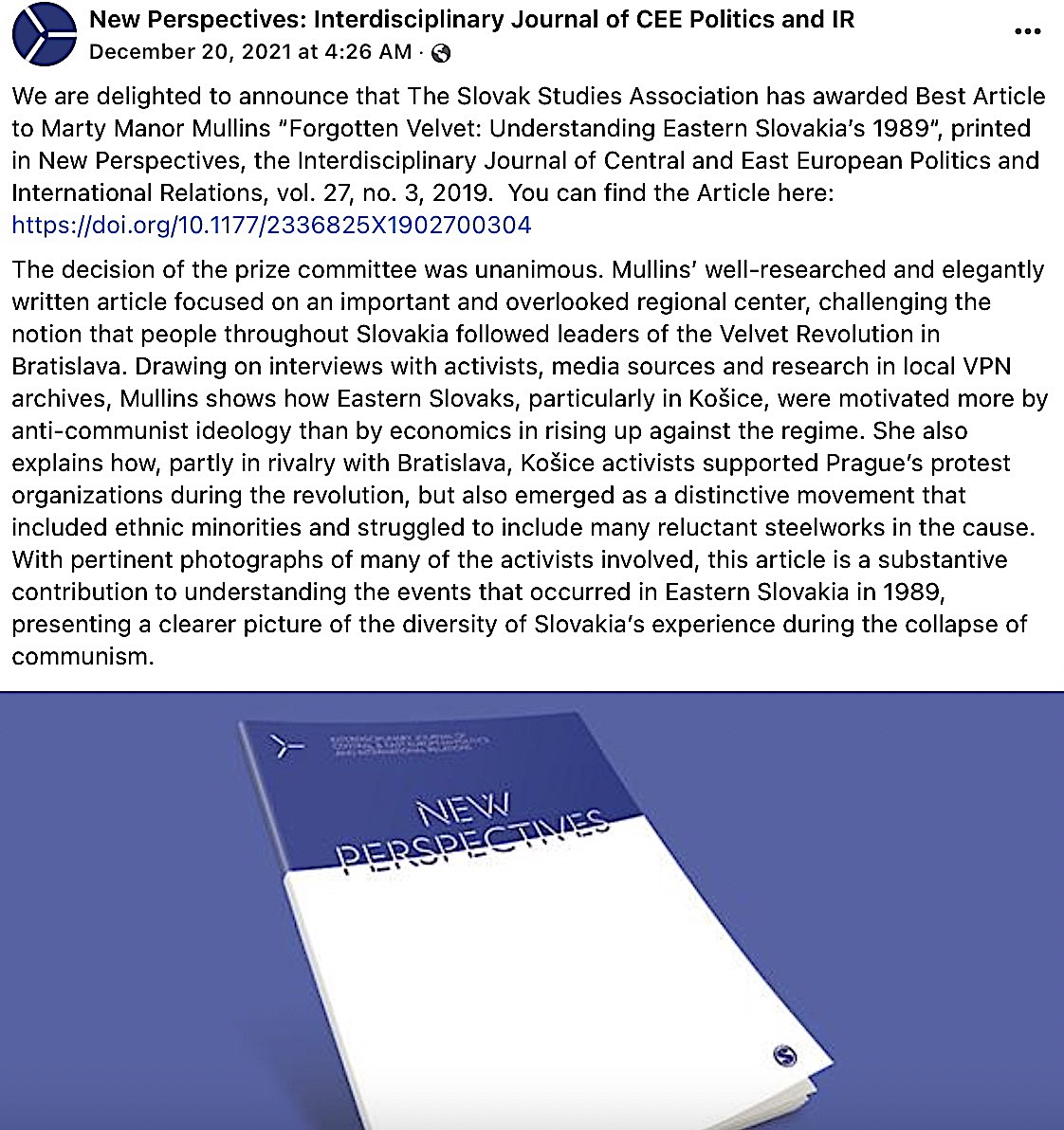
The decision of the prize committee was unanimous. Mullins’ well-researched and elegantly written article focused on an important and overlooked regional center, challenging the notion that people throughout Slovakia followed leaders of the Velvet Revolution in Bratislava. Drawing on interviews with activists, media sources and research in local VPN archives, Mullins shows how Eastern Slovaks, particularly in Košice, were motivated more by anti-communist ideology than by economics in rising up against the regime. She also explains how, partly in rivalry with Bratislava, Košice activists supported Prague’s protest organizations during the revolution, but also emerged as a distinctive movement that included ethnic minorities and struggled to include many reluctant steelworks in the cause. With pertinent photographs of many of the activists involved, this article is a substantive contribution to understanding the events that occurred in Eastern Slovakia in 1989, presenting a clearer picture of the diversity of Slovakia’s experience during the collapse of communism.
All the submissions in this year’s competition were of high quality and addressed interesting and engaging topics that reflect the richness of current scholarship on Slovakia. These included Stanley Kirschbaum’s “Sister Margit Slachta of Hungary and the deportation of Slovak Jews,” Canadian Slavonic Papers, vol. 61, no. 1, 2019; Juraj Buzalka’s “Post-peasant Memories: Populist or Communist Nostalgia,” East European Politics and Societies and Cultures, vol. 32, no. 4, 2018; James Krapfl’s “From the Socialist Revolution of 1989 to the ‘Real’ Revolution of 1990,” in From Revolution to Uncertainty, von Puttkamer, Borodziej and Holubec (eds.), Routledge, 2020; James Krapfl and Kieran Williams’ “For a Civic Socialism and the Rule of law,” in Eastern Europe in 1968, McDermott and Stibbe (eds.), Palgrave-MacMillan, 2018; and James Krapfl and Andrew Kloiber’s “The Revolution Continues: Memories of 1989” published in the online journal Cultures of History Forum.
The prize committee consisted of Edward Snajdr (Chair), Susan Mikula, Greg Ference and Mark Stolarik. The committee commends and thanks all the scholars who submitted their work for the prize and wish them all the best in their continuing scholarly endeavors.
We congratulate Marty on winning this year’s prize!
Ed Snajdr–Chair, SSA Prize Committee
2018 Article/Book Chapter Prize Winner
The winner of the 2018 SSA Article/ Book Chapter Prize is Jonathan L. Larson. His submission, “Wild Eavesdropping: Observations on Surveillance, Conspiracy, and Truth in East Central Europe” appeared in Political and Legal Anthropology Review (PoLAR), vol. 40, no. 2, 2017.
In his study, Larson looks at the phenomena of surveillance and eavesdropping in certain states of East Central Europe, including in Slovakia. He finds that, unlike in the Western world, where people would be outraged at the use and release of secret tape-recordings as a violation of their privacy, the people of East Central Europe do not mind such behavior, because it reveals the true thoughts/feelings of politicians, who are suspect in the eyes of the general public.
His analysis astutely links security and surveillance to the legacies of state socialism but also to emerging technologies and the complicated processes of post-socialist democratization. While Slovakia is one of several cases that Larson examines, he ties in all his evidence and demonstrates the importance of developments in Slovakia as not only indicative but even emblematic of broader social and political developments in the region. Moreover, both Larson’s thesis and his data are comprehensively contextualized in the theoretical literature of the anthropology of post-socialism and its larger relevance to the contemporary global condition.
Larson’s article link is: https://anthrosource.onlinelibrary.wiley.com/doi/full/10.1111/plar.12224 You may also request a copy through Researchgate
Other 2018 submissions:
- -Philip J. Howe, Thomas A. Lorman and Daniel E. Miller’s “The Creation of the Conditions for Consociational Democracy and Its Development in Interwar Czechoslovakia.” 2016. Bohemia 56, 2, pp. 362-380.
- -Stanley Kirschbaum, 2015. “Monasticism in Slovakia and Slovak National Development,” in Monasticism in Eastern Europe and the Former Soviet Republics, Ines Angeli Murzaku (Ed.), London: Routledge. pp. 62-85.
All three submissions, in their own distinctive ways, point to the importance and the value of sophisticated interpretations and analyses of Slovakia’s role in the larger cultural, political and historical currents in regional and global contexts.
The committee commends all of the scholars who submitted their work for the prize and wish them all the best in their continuing scholarly endeavors. We congratulate Jonathan on winning this year’s prize!
Treasurer’s note from Carol Leff: In a historical first, the treasurer presented the prize check to the winner in person and took him out to dinner. If you come to Champaign-Urbana to get your prize check, she will do the same for you!
2017 Graduate Paper Award Winner
The winner of the 2017 SSA Graduate Paper Award is Vincent Post with the submission:
“Slovakia: No Saints, No Sinners.” Paper presented at the Association for Slavic, East European, & Eurasian Studies conference in San Antonio, TX, 2014.
2016 Article/Book Chapter Prize Winner
The winner of the 2016 SSA Best Article/Book Chapter Prize is Charles Sabatos with the submission:
“Between Two Worlds: Slovak Language and American Identity in Out of This Furnace.” Comparative American Studies 11 (March 2013): 74-88.
2015 Best Book Prize Winner
The winner of the 2015 SSA Best Book Prize is James Mace Ward with the submission:
2015 (Book Award) Ward, James Mace. Priest, Politician, Collaborator: Jozef Tiso and the Making of Fascist Slovakia. Cornell University Press, 2013.